This year I started to do a lot more school programs than I have before at Black Swamp Bird Observatory. The pandemic brought us to a lot of virtual programming, but 2023 lent us the opportunity to do some outreach to students and adults. I did a LOT of public speaking in the community as a journalist and found it easy to speak on things that I knew a lot about. I have to admit, it did take me some time to ease into giving educational programs.
Luckily, I had a lot of people around me – specifically my coworkers Ryan and Becca – that helped show me the way and gave me the confidence to be effective. I can remember throughout my twenties being pretty serious and not allowing myself to loosen up and be silly and have fun. I mean, I had fun – I am incredibly hilarious 😉 – cracking jokes and things like that, but to be silly on a level where its borderline embarrassing to appease children isn’t something that was ever in my cards. That has changed.
To my surprise, I thoroughly enjoy talking to students about birds. To be honest, I was skeptical at first. I love my nephew, but I never really wanted kids of my own. I’d much rather just collect dogs, but, as I said, to my surprise, I really like it. And it seems I’m at least kind of good at it.
Some highlights before I share my most favorite moment:
I made my own bird craft! That’s right – watch out Pinterest! I made a template of a hummingbird, cardinal, and eagle and for some big table events, we had a build your own bird activity. Students got to color their birds, inspired by real birds or imaginary, put them together, and learn some bird facts. I loved being able to tie art and creativity into learning about birds.
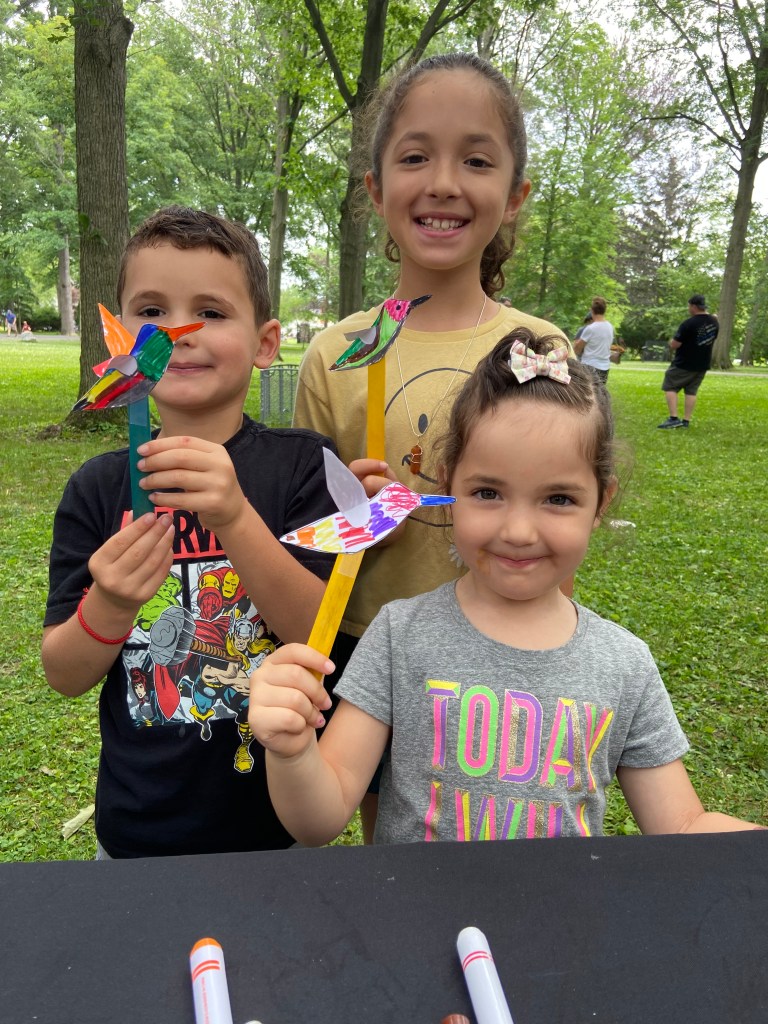
These are my cousin’s babies with the hummingbirds they made at Grove Fest in Fremont.
I also arranged some themed programs concentrated on certain adaptations of birds or specific families of birds. We did an Audubon kids bird beak activity at an event, a program about hummingbirds, and quite a few programs about owls.

Annalise, Ryan, and I traveled to the Kelley’s Island field station for the day to talk to students about birds and owls for their nature camp. The first group of the day was little itty bitty students and it was so fun to have them mimic the sounds an owl makes. This is one of the times where being able to be silly comes in. When it was time to do the sound of a female Great Horned Owl, I got to be loud and low with my hoots and it made some of the students laugh.
There were also a lot of riveting games of Jeop-bird-y throughout the year. I have found the success of this program all in the delivery. It also helps to have questions like “A Turkey Vulture projectile vomits as a defense mechanism. How many feet can a Turkey Vulture projectile vomit?” What do you think the answer is?
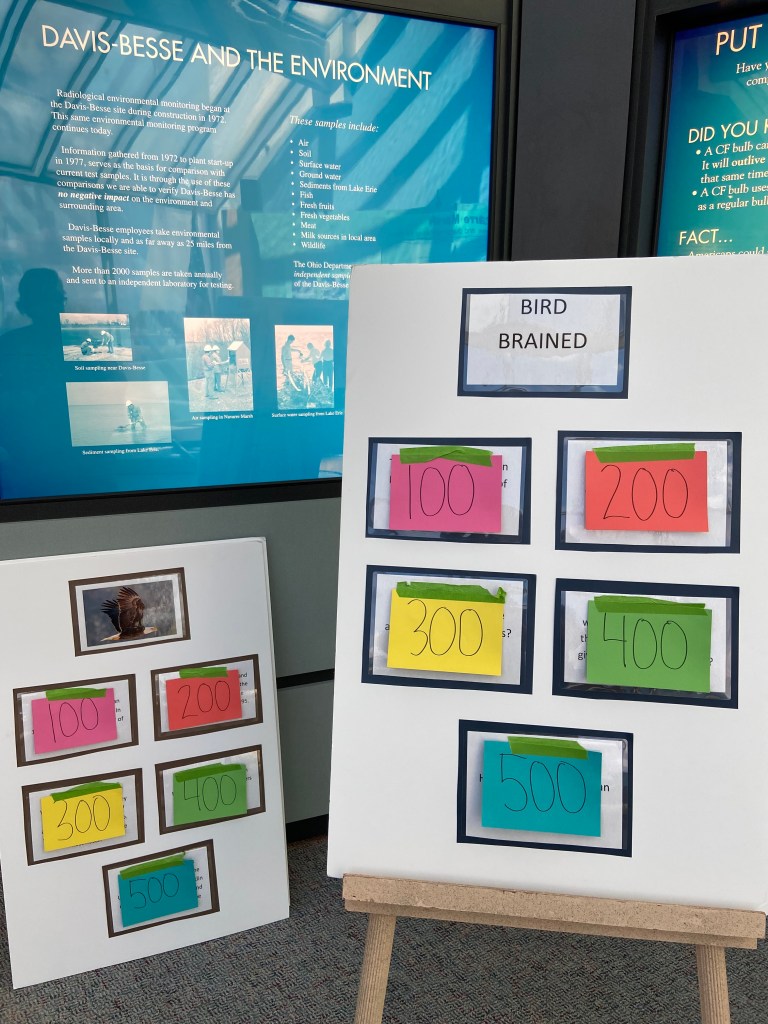
I also had a category that was just about Bald Eagles and was specific to Ohio. It included data from the Ohio Division of Wildlife Bald Eagle survey and had lots of information about humans’ role in the environment and lots about conservation.
One of the best days of the year, in my opinion, was spent at Earth Heart Farms in Oak Harbor. Fifth graders from Margaretta came and we took groups of students out onto the land and let them decide what we were going to focus on. I really feel this is the best way to approach something like this. When you take students out into the field and only focus on one thing (say birds), its a disservice to the students and the experience. I was paired with a teacher and I was designated as the naturalist. If we saw a frog, we would talk about frogs. If a student was really into a beautiful flower, we would stop and talk about wildflowers. It was an inspiring day getting to spend time with curious, engaged students.
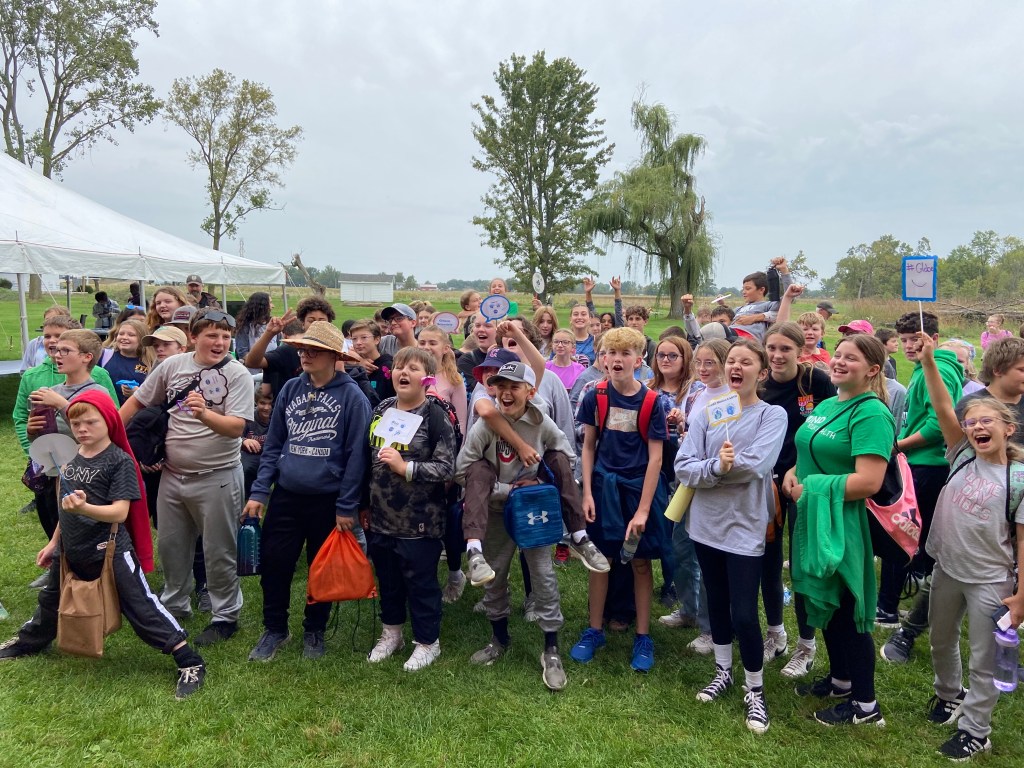
These were the students at the end of the day. What a great photo to represent the excitement of the day.
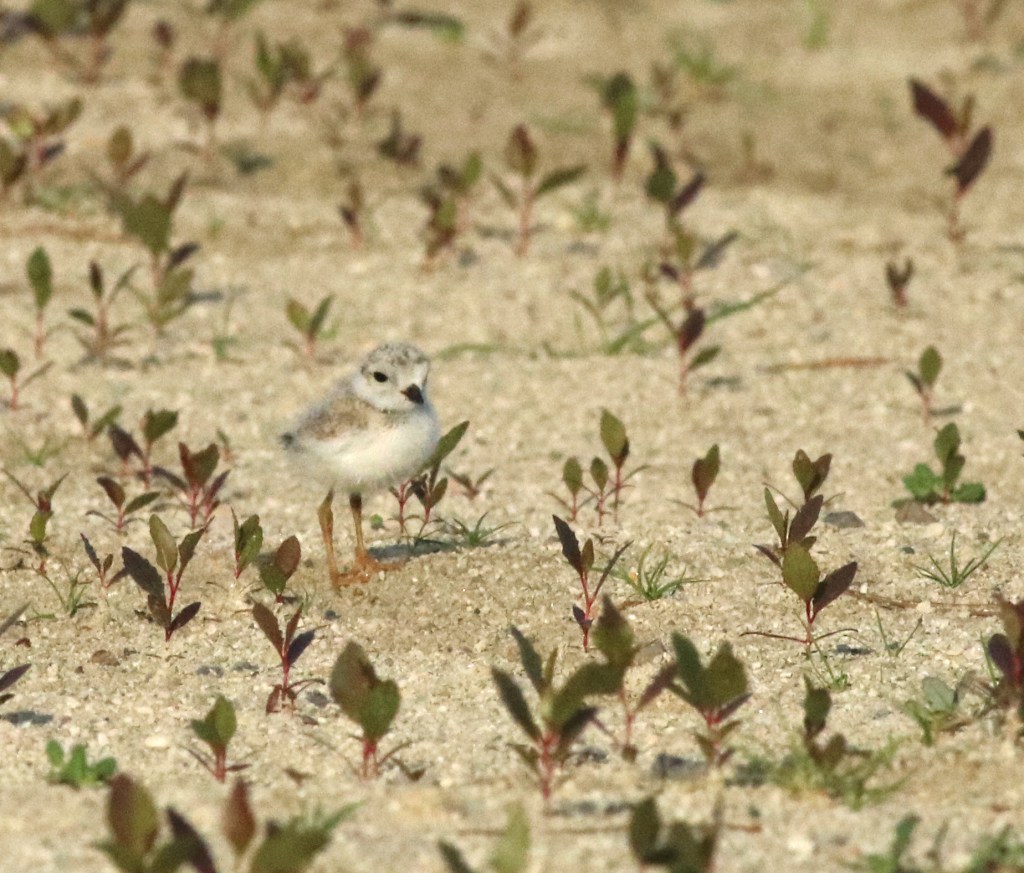
Those were some highlights. Now, I’d like to share my favorite school program/student interaction of the year. The introductory photo for this post is a Piping Plover chick that I took while monitoring during the summer of 2021. During the fifth grade Conservation Day at Ottawa National Wildlife Refuge that’s organized through the Ottawa County Soil and Water Conservation District Black Swamp Bird Observatory was there talking about birds, ecology, bird migration, and we had some mounts of birds and talked about those birds specifically.
One of the mounts is a male and female Baltimore Oriole with their nest. Talking about this mount offers a great opportunity to discuss sexual dimorphism, adaptations, and camouflage. While engaging the students, I got them to tell me why the female would have to be the same color as the nest – camouflage! One girl raised her hand and asked “Why does the female have to sit on the nest? Why can’t the male sit on the nest, too?” “That’s a great question!” I responded. I explained that with most birds, the female is typically the one who sits on the nest and tends to the young, but there are some species that share responsibilities or the male tends to the young.
I went on to explain that Black Swamp Bird Observatory had the opportunity to monitor a nest of Piping Plover a few summers ago. They needed help being monitored because they are an Endangered Species and humans have had to intervene to help regrow the population. And, indeed, one of the species where the male takes more of the role in raising chicks is the Piping Plover! Both parents sit on the nest, taking turns taking care of themselves and taking care of the nest. A little while after the eggs hatch, the female Piping Plover leaves and flies south for migration. The male Piping Plover primarily teaches the chicks to forage and fly.
There was some more discussion and comments and then we moved on. The second part of the time the students had with us that day was a migration relay race where the students are our bird extractors and they race to extract stuffed birds out of a mist net. As the students were returning the birds, a girl came up to me and said “my family is like the Piping Plovers.” “Oh yeah? How’s that?” I asked. “I haven’t seen my mom in three years. She was here, but she’s not here now. It’s just me and my dad so we are just like the Piping Plover family!” she said excitedly. “Wow, that’s really neat!” I said back to her. She skipped away, happy, after sharing the information with me.
I think about this often. Its just yet another reason how representation can matter; how information can broaden someone’s understanding. I could tell the information that I shared about the plovers made that girl proud of her family and made her happy to think of it in a way that they were plovers. A situation another student may have found negative was positive for her.
I’m thankful that I got to meet and interact with these special students. I am hopeful that they learn something from me, but am always prepared for the opportunity to learn something from them.
 Great Lakes Pelican